
Council of Heads of Australasian Herbaria
Australian National Herbarium
Biographical Notes

|
|
Council of Heads of Australasian Herbaria |
|
 Byrnes,
Norman Brice (Norm) (1922 - 1998)
Byrnes,
Norman Brice (Norm) (1922 - 1998)Born on 18 December 1922 in West Torrens, Adelaide, SA; died on 6 November 1998, with a monument in the Queensland Garden of Remembrance, Bridgeman Downs, City of Brisbane, Qld.
(Plot info: Wall 8 Row J.)
He spent part of his childhood growing up in a house directly opposite the Adelaide Botanical Gardens - a fateful landmark in the life of someone later to become a botanist.
During the years of the Great Depression the Gardens were surrounded by fences to prevent homeless people from settling on the park grounds. This however proved no barrier to young Norman who managed to continue his explorations of the gardens by entering through the drain pipes. If anything, the subterranean route only added to the boy's sense of adventure.
Following a breakdown in the relations between Norm's parents what was left of the family eventually moved to Sydney, more exactly to Yowie Bay, then a bushy location.
At the age of 15 Norm became a high school drop-out, - not for lack of interest or satisfactory marks but simply because the boy hoped to get a job to help pay family bills during the great Depression. He had the second highest marks in his school. But when he found no work he enrolled in night school at the local tech and began his formal study of science. The tech science course also was never finished (though a high school diploma was received) for at the age of 18 Norm was drafted to army during WWII.
He was stationed for a time on the Atherton Tablelands and for a time in New Guinea. He was discharged in 1943 with malaria after being in active service with the 110 Light Anti-Aircraft Regiment for a year and a half.
In 1945, Norm married his lifelong wife Joan who he'd known from the age of seven. With the war over, he tried to resume his science course at the tech while working as an apprentice.
Universities were expensive in those days, but, as an ex-serviceman he was entitled to assistance from the government. He graduated BSc at the University of Sydney in 1946, then did a Dip Ed.
Diploma in one hand, wife in the other, he eventually arrived in Casino where he worked as a teacher of high school maths and science. Later he worked as a lecturer at the teachers' college in Bathurst and then again as a high school instructor, this time in Coffs Harbour.
At some point (~1961), there was a move to Lismore where Norm took up a career as a chemist - working for the Department of Agriculture.
Norm's job in Lismore was chiefly to investigate the effects of arsenic and DDT in cattle-dip formulas.
But, he was forbidden to publish articles on his research into toxin detection in meat, lest the USA applied his new techniques to Australian meat and ban its import. Nonetheless, the government recognised Norm's talent and wisely invested in his education, training him (in Sydney) to be one of Australia's first experts in spectrophotometry. By analysing the colour-bands of burning substances Norm would soon be able to detect even more minute quantities of poison than he had in the past.
In 1965, Norm moved to Darwin as a research botanist at the NT Herbarium and did his MSc thesis there. Just before Cyclone Tracey in 1974, he left Darwin to join the Queensland Herbarium in Brisbane.
Health issues, probably related to his research on toxins, caused him to be hospitalised owing to his exposure to phosphates. After that he often stuttered and had to wait for a break in his palsy before he could go on.
Norm retired from public life to start a tree farm in northern New South Wales and turned a windswept wasteland into a lush forest. But the place was too windy and wet, and Norm and Joan didn't like it, so they put the tree farm behind them and set off for north Queensland, eventually, in 1988, arriving at Bingil Bay. Norm was then 65.
NORM BYRNES ARBORETUM
This small pocket of accessible rainforest, with many of its trees labelled, is located alongside the 'Community for Coastal and Cassowary Conservation' (C4) Environmental Centre in Porters Promenade, Bingil Bay. It was named after Norman Brice Byrnes, the botanist who created it. When the primary school announced their relocation from Boyett Road to Wongaling Beach in 1992, Norm was let loose on the site to create an arboretum.
In his last days he showed daily courage in contending with a debilitating degenerative disease and he died on 6 November 1998.
His research centred on the plant families Combretaceae
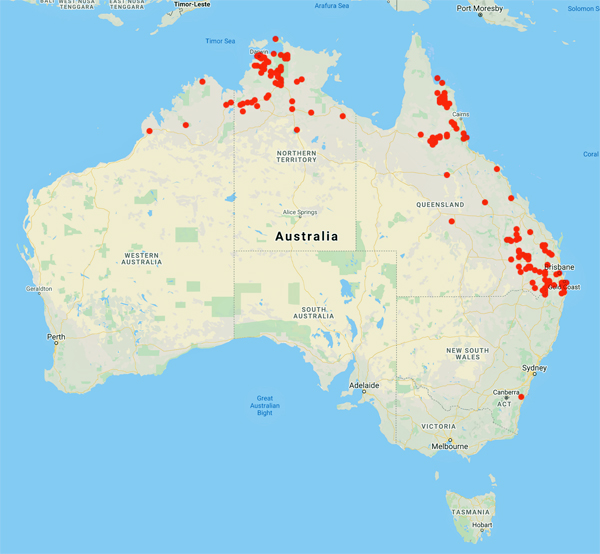
and Myrtaceae, and his herbarium collections are to be found in BRI and DNA.
Several plant species including Goodenia byrnesii and Grevillea byrnesii have been named in his honour.
Source: Extracted from: A.E.Orchard (1999) A History of Systematic
Botany in Australia, in Flora of Australia Vol.1, 2nd ed.,
ABRS.
https://mbhs.com.au/index.php/our-town/environment/157-norm-byrnes-arboretum
Bingil Bay Botanist - The Story of Norm Byrnes & His Arboretum, by Dr Bob Jones & Ken Gray
https://www.findagrave.com/memorial/250952460/norman-brice-byrnes - Norman Brice Byrnes (MONUMENT)
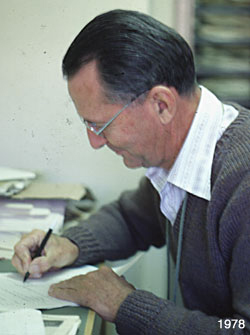
Portrait Photo: 1978, George Chippendale, now in ANBG Photo Collection
Data from 567 specimens